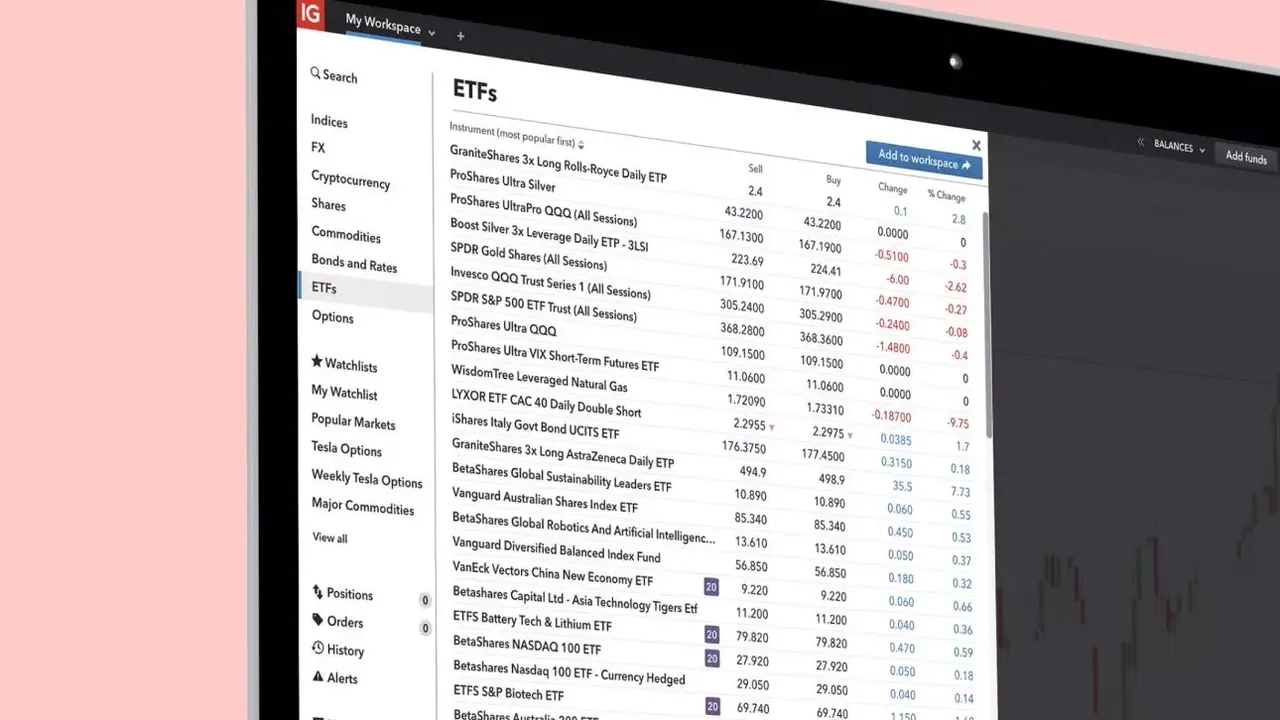


What is an ETF and how does it work?
Most ETFs are passive investment instruments designed to replicate the returns of an index rather than beat it. This simplicity, combined with low ongoing charges, makes them one of the most cost-effective and widely used investment instruments available to UK retail investors. Our stocks and shares ISA allows you to hold ETFs with all gains and income sheltered from UK tax permanently within the £20,000 annual allowance.
How to invest in ETFs in the UK
1. Choose your account type
Most long-term ETF investors use a stocks and shares ISA for the tax efficiency, or a SIPP for retirement savings with upfront tax relief. A general share dealing account suits amounts above the £20,000 ISA limit. All three account types allow you to hold ETFs and buy and sell them during market hours.
2. Decide which type of ETF exposure you want
The first decision is what you want your ETF to track. The most popular choice for UK investors is a broad global equity index, providing exposure to hundreds or thousands of companies across developed markets in a single trade. FTSE 100 trackers are widely held for UK equity exposure, while S&P 500 trackers provide pure US market exposure. Thematic ETFs focus on specific sectors such as AI, clean energy or technology. UK ETFs and global ETFs are covered in detail in their respective guides.
3. Compare ETFs on cost and structure
For two ETFs tracking the same index, the most important differentiator is the ongoing charge figure (OCF), also called the total expense ratio (TER). This is the annual percentage fee deducted from the fund's assets. For major index ETFs, OCFs range from 0.03% to 0.25%. Over a 20-year holding period, this difference compounds significantly. The differences between index funds and ETFs also matter for cost: ETFs involve bid-offer spreads when trading; traditional index funds do not.
4. Choose between accumulating and distributing
Accumulating ETFs reinvest dividends within the fund, which suits ISA investors who want growth without receiving cash payments. Distributing ETFs pay dividends out as cash. For most ISA investors focused on long-term growth, accumulating is typically more efficient since dividends are automatically reinvested without dealing costs. For income-focused investors or those in drawdown, distributing suits better.
5. Place your order
Search for the ETF by name or ticker symbol on our platform. Review the current price and the bid-offer spread. Place a market order (executes at the current available price) or a limit order (only executes if the price reaches your specified level). For UCITS ETFs listed on the LSE, settlement is T+2.
ETF investing: key facts
0.03%
Lowest OCF available on S&P 500 UCITS ETFs for UK investors (SPDR UCITS, SPY5)
£20,000
Annual ISA allowance for 2026/27, within which ETF gains and income are permanently tax-free
11,000+
Global shares and funds available on our platform, including the widest range of UCITS ETFs
A FTSE tracker ISA: the most popular starting point
For many UK investors, a FTSE 100 or global equity tracker held in a stocks and shares ISA is the most common first ETF investment. The iShares Core FTSE 100 UCITS ETF (ISF) and the Vanguard FTSE All-World UCITS ETF (VWRL) are among the most widely held UK-listed ETFs, offering either UK equity or global diversified exposure at OCFs of 0.07% and 0.22% respectively.
Holding either within a stocks and shares ISA means dividends and capital gains accumulate tax-free permanently, regardless of how large the position grows over time. There is no time limit on the tax-free protection and no restriction on how large the fund can become. The annual allowance only restricts how much can be contributed each tax year, not how much can be held.
Trading ETFs with spread bets and CFDs
For shorter-term traders, we offer spread bets and CFDs on major ETFs, providing leveraged exposure to index performance without owning the underlying fund. This allows you to go short on an ETF (profiting from a decline in the index) or take a leveraged long position. These are not investment products: they are leveraged derivatives suited to short-term tactical positions. Spread bet profits are free from CGT.
For investors who want to access US-listed ETFs such as the SPDR S&P 500 ETF Trust (SPY), direct investment by UK retail investors is restricted under PRIIPs regulations. UCITS equivalents listed on UK exchanges are the accessible alternative for long-term investment. For spread betting and CFD trading, many US-listed ETFs remain accessible through our platform.
Spread bets and CFDs are complex instruments and come with a high risk of losing money rapidly due to leverage. 69% of retail investor accounts lose money when trading spread bets and CFDs with us. You should consider whether you understand how spread bets and CFDs work, and whether you can afford to take the high risk of losing your money.
Robust risk management strategies, including stop-loss orders, should be understood and used to prevent losses beyond a set level.
ETF investing FAQs
Open a stocks and shares ISA, SIPP or share dealing account with a regulated platform, search for the ETF by ticker or name, and place a buy order. Most UCITS ETFs listed on the London Stock Exchange are ISA-eligible and settle in two business days.
The cheapest UCITS ETFs for UK investors are S&P 500 trackers with OCFs of 0.03% to 0.07%, including the SPDR S&P 500 UCITS ETF (SPY5) at 0.03% and the Vanguard S&P 500 UCITS ETF (VUAG) at 0.07%. FTSE 100 trackers such as the iShares Core FTSE 100 UCITS ETF (ISF) also carry a 0.07% OCF.
Yes. UCITS ETFs listed on recognised exchanges are ISA-eligible. All capital gains and dividend income within the ISA are permanently sheltered from UK tax within the £20,000 annual allowance. This is the most tax-efficient route for most long-term ETF investors.
Accumulating ETFs reinvest dividends internally, growing the fund's net asset value. Distributing ETFs pay dividends out as cash. For ISA investors focused on growth, accumulating is typically preferable since reinvestment happens without dealing costs or dividend processing. For investors who want regular income, distributing ETFs are more suitable.
Yes. We offer spread bets and CFDs on major ETFs and the indices they track, providing leveraged exposure for shorter-term trading. These products carry significant risk: 68% of retail investor accounts lose money when trading spread bets and CFDs with us. They are not suitable as long-term investment vehicles.