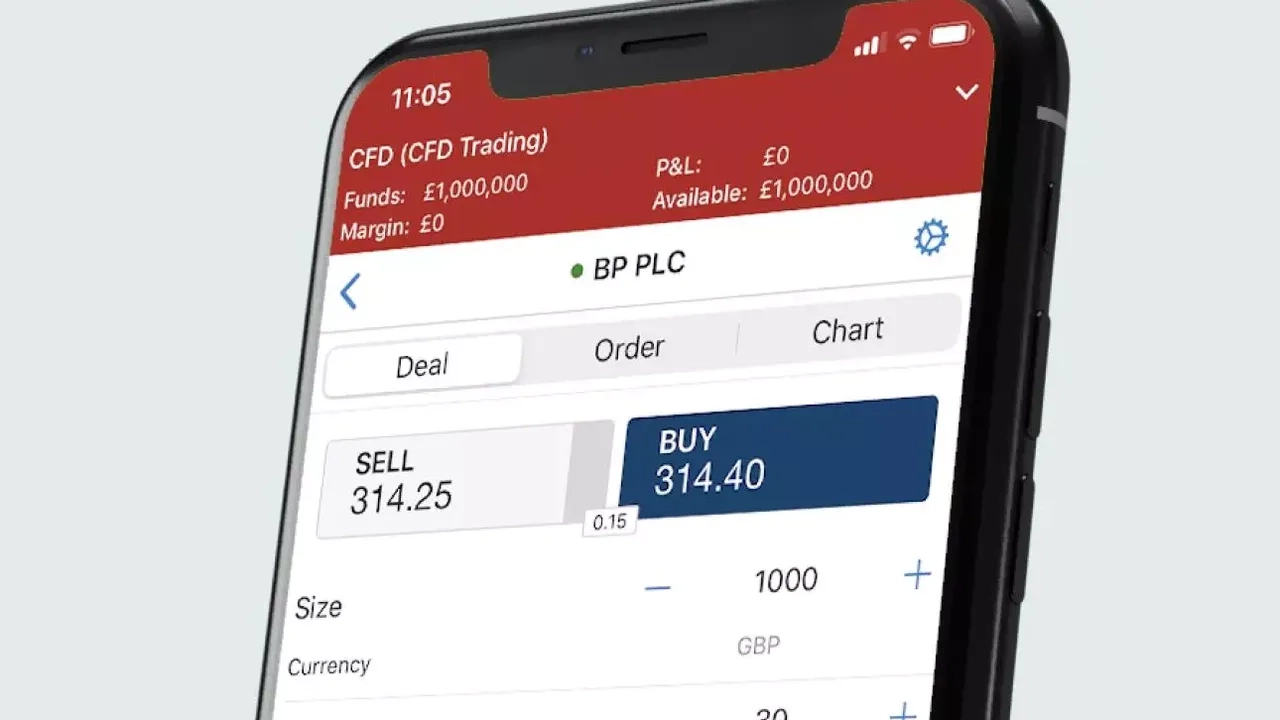


6 steps to trading CFDs
Step 1: Learn what CFD trading is
Your first step towards trading CFDs is to learn how they work. Read our quick introduction: what is CFD trading and how does it work?
Step 2: Create and fund a CFD trading account
Creating a CFD trading account with us is easy:
Fill in a simple form — we'll ask about your trading knowledge to ensure you get the best experience
Get instant verification — we can usually verify your identity immediately
Fund and start trading — you can also withdraw your money easily, whenever you like
Create your account to begin CFD trading
Not ready to trade CFDs yet? Build your confidence in a completely risk-free environment with a demo account, and practise with £10,000 in virtual funds.
Step 3: Choose your market and timeframe
One of the features of CFD trading is that there are a variety of ways to trade. We offer 15,000+ markets, including:
Shares — over 11,000 international shares
Indices — over 80 indices including the FTSE 100, Wall Street and US Tech 100
Forex — including all the major, minor and exotic currency pairs
Commodities — over 30 commodities, from precious and base metals to oils, gas and softs
Other markets — including ETFs, bonds, options, thematic baskets and more
Learn more about all our CFD markets
There are also different ways to trade CFDs: via spot markets and via futures.
Spot trading is best for shorter-term trading, as the spot price is the immediate real-time price of the asset
CFD futures are best for medium to longer-term trades, as they allow you to speculate on the price that the underlying asset will be on a specific future date
Step 4: Decide whether to buy or sell
With CFDs, you can take a 'buy' or 'sell' position on an underlying market. You'd 'buy' if you thought the price was going to rise, and you'd 'sell' if you thought it was going to fall.
Learn more about our trading platforms
CFDs are leveraged, meaning that you can receive full market exposure for a deposit, known as a margin. Your margin is a product of leverage — think of it as the deposit with which you open the position. Trading on margin enables you to get exposure to the full value of the trade without committing the higher value upfront.
So, if you wanted to open a £100 position on Apple shares, you'd put down a margin of £20 (20% of the position size). It's important to remember that, while leverage can help to amplify your profits, it can also increase your losses — because your profit or loss is still calculated on the full size of your position.
The difference in price between the 'buy' price and 'sell' price for an asset is called the spread. You'll need the current market price to pass above our buy price when going long, or fall below our sell price when going short, in order to make a profit.
The spread varies depending on market conditions. In most cases we charge our own spread on top of the market spread, as our fee for the trade. Spread charges apply to CFD trades for all markets except shares — for every shares CFD trade, you'll pay a commission instead of a spread.
Step 5: Set your stops and limits
Once you've decided on what to trade and the position size (and margin) you want, it's time to set stops and limits. Because a trade's profit or loss is only calculated once it's closed, stops and limits are parameters that close your trade automatically once it has reached the level of profit or loss you're comfortable with.
In this way, your stops and limits help you to calculate potential profits and losses from your CFD trades. They can also be useful ways to lock in profits or minimise your exposure to risk.
Learn more about risk management
Under the 'size' button, choose an amount for your stop order — an order to close your trade when the market price moves to a level which is less favourable to you. A limit order is the opposite: an order to close the trade when the market moves to a level which is more favourable to you.
Step 6: Open and monitor your CFD trade and close your position
As soon as you've opened your trade by clicking 'place deal', you can watch it in real time on our CFD platform to see how you're doing. You can monitor all your open CFD trades within our award-winning platform and, when you're comfortable with the profit you have made — or wish to limit any further loss — close your position by clicking the 'close' button.
Your profit or loss is calculated by multiplying the amount the market moved by the size of your trade in pounds per point.
CFD trading examples
We've put together some CFD trading examples to guide you through the process of trading CFDs on a range of markets including shares, indices, commodities and forex.
Index CFD trade example
Let's say you want to speculate on the FTSE 100 index going up from its current price of 10,650 (buy 10,651.2, sell 10,648.8). You buy 100 FTSE 100 CFDs at the buy price of 10,651.2. A single FTSE 100 CFD is worth £10, so if you predict correctly and the FTSE 100 rises to 10,665 (buy 10,666.2, sell 10,663.8), and you close your position by selling at the new sell price of 10,663.8, you'd have made a profit of £12,600 ([10,663.8 – 10,651.2] x £10 x 100 CFDs).
If the index moves against you and drops to 10,630 (buy 10,631.2, sell 10,628.8), and you close your position by selling at the new sell price of 10,628.8, you would have made a loss of £22,400 ([10,651.2 – 10,628.8] x £10 x 100 CFDs).
Spot gold CFD trade example
You believe the price of gold is going to rise from its current level of 4,100.00. You buy five 'Spot Gold Mini (10oz)' CFDs, each with a contract size of $10 per point of movement — bringing the total to $50 per point (5 CFDs x $10 per point). As you're buying slightly above the underlying market due to the spread, the current buy price is 4,101.00.
Spot gold CFDs have a margin factor of 5%, so you'd need to deposit $10,252.50 ($50 x 4,101.00 x 5%) to open a position worth $205,050. It is important to note that because this latter amount is your total exposure, your losses could exceed your margin deposit.
The spot price of gold does increase, up to a new price of 4,115.00. You decide to close your position at the new sell price of 4,114.00. The market moved in your favour by 13 points, so you'd be taking a profit of $650 (13 points x $50) — excluding other costs.
In cases where our CFDs are denominated in US dollars, your profits or losses will be realised in dollar terms and then converted into pounds at the prevailing rate of exchange.
Forex CFD trade example
Assume that the GBP/USD pair is trading at 1.33985, with a buy price of 1.33990 and a sell price of 1.33980. Because you believe that the pound is set to appreciate against the dollar, you buy a standard GBP/USD contract at 1.33990.
Buying a single standard GBP/USD CFD is the equivalent of trading £100,000 for $133,990. You decide to buy three CFDs, giving you a total position size of $401,970 (£300,000). Because you're trading the forex pair using leverage, your margin will be 3.33%, which is $13,385.57 (approximately £9,990). You could add a stop to your position to manage your exposure to risk.
Your prediction was right and the pound rose to 1.35500 against the US dollar. You can now reverse your trade to close your position by selling three contracts at the new sell price of 1.35495. Your profit from this would be $4,515 ($406,485 - $401,970).
1.35495 (USD sell price) x 3 (contracts) x 100,000 (lot size) – 1.33990 (USD original buy price) x 3 (contracts) x 100,000 (lot size) = $4,515
If your prediction was wrong and the pound fell to 1.32500 against the US dollar (sell price of 1.32495), you'd still reverse the trade to close it, but you'd make a loss of $4,485 ($397,485 - $401,970).
1.32495 (USD sell price) x 3 (contracts) x 100,000 (lot size) – 1.33990 (USD original buy price) x 3 (contracts) x 100,000 (lot size) = -$4,485
In either case, there would be no commission to pay but you'd have to pay a funding charge to keep your position open overnight.
FAQs
With IG, you can trade CFDs on over 15,000 markets, including indices, shares, forex, commodities and more. You can even trade CFDs out of hours on certain markets, enabling you to make the most of company announcements after the market closes.
Whether you're new to trading or have previous experience, CFD trading can provide a wide range of benefits — including the opportunity to deal on thousands of markets without the need for large amounts of capital. However, it is important to be aware that CFD trading is not for everyone. As it is a leveraged product, losses can exceed deposits. This means it is especially important to understand the risks involved and take steps to prepare yourself before you start trading CFDs.
With IG, you'll need to fund your account by a minimum of £250 to get started. The costs of CFDs depend on the market you choose, changing according to factors such as liquidity. You generally only pay a commission charge for share CFDs, and a spread for all other markets. Plus, every market comes with its own minimum number of contracts you will need to buy or sell to open your position. There is also a small charge to fund positions overnight and for guaranteed stops (if triggered), and there may be additional fees for specialist tools. See our full charges and fees.
With IG, you can trade CFDs on our online trading platform and on the go with our mobile trading apps. You can also use our services with specialist third-party platforms such as L2 Dealer, ProRealTime and MetaTrader 4. Discover our range of award-winning platforms.
To open a new CFD trading account with IG, you just need to fill in a simple form so that we can establish your previous experience and available funds. Our mobile trading apps, state-of-the-art technology and free educational tools make the process of switching your account to us straightforward — you can be signed up and ready to trade within minutes.