Best alternative investments to diversify your portfolio
Not all financial instruments are traded on a public exchange. You can also buy privately owned assets, which are a form of alternative investments. Explore alternative investments that can be used to diversify your portfolio.




Key Takeaway
Alternative investments — including gold, commodities, private equity, infrastructure, and hedge funds — can reduce portfolio volatility by providing returns that are not correlated to stock market movements, though they typically involve greater illiquidity, complexity, and fees than traditional assets. With IG, the most accessible alternatives are available via spread bets, CFDs, and share dealing on commodity ETFs and listed alternatives funds.
What is an alternative investment?
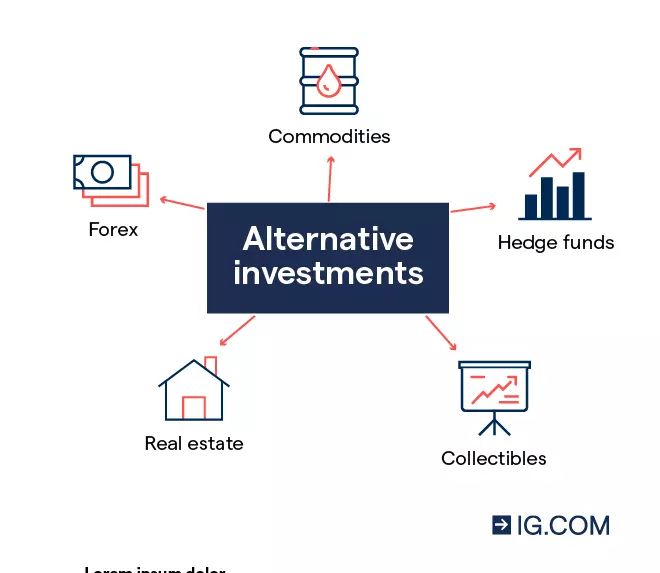
An alternative investment is a private asset that differs from traditional markets such as stocks and bonds, often traded on an exchange. These private assets include venture capital, private equity, derivative contracts, real estate, hedge funds and futures.
The positives of alternative investments include the ability to hedge them against inflation as well as their low transaction costs compared to listed ones. However, with alternative investments’ opaque legal structure, this asset class is likely to be subjected to scams. All the more reason why it’s important to ensure you use a regulated broker when investing in this asset class.
Why add alternatives to a portfolio?
The primary case for alternatives is diversification — they tend to move independently of equities and bonds, which reduces overall portfolio volatility without necessarily reducing returns.
During the 2008 financial crisis, global equities fell 40-50%. Select alternative categories — including commodities, managed futures, and certain hedge fund strategies — posted positive returns over the same period. More recently, gold delivered a 27% return in 2024 and reached new all-time highs in April 2025 above $3,500 per troy ounce, while equities experienced significant volatility during the same period.
A balanced allocation might combine 20% alternatives with 80% core equities, bonds and cash — split across listed infrastructure trusts, bond substitutes, a gold ETF, and selective commodity exposure.
Gold and precious metals
Gold is the most widely held alternative asset among UK retail investors and the most accessible. It has historically acted as a store of value during periods of economic stress, currency weakness, and inflation, and tends to be negatively correlated with the US dollar.
Gold reached a record high above $3,500 per troy ounce in April 2025, driven by central bank buying, US dollar weakness, geopolitical uncertainty, and strong demand from Asian investors. As of June 2026, prices have moderated but remain significantly elevated relative to five-year averages.
For UK investors, the most practical routes to gold exposure are gold ETFs — such as the iShares Physical Gold ETC (SGLN) or the Invesco Physical Gold ETC (SGLD), both London-listed and ISA-eligible — or spread bets and CFDs on spot gold prices, which are available through our platform with no stamp duty and, for spread bets, free from CGT.
Silver, platinum, and palladium offer similar inflation-hedging and store-of-value characteristics, with higher volatility and more industrial demand drivers than gold. All are available to trade with us.
Commodities
Commodities encompass physical goods including energy (oil, natural gas), metals (copper, aluminium, nickel), and agricultural products (wheat, corn, soybeans, coffee). They are among the most directly inflation-sensitive assets — their prices tend to rise when general price levels rise, since they are the raw inputs to the economy.
The commodity cycle turned in 2021 as post-pandemic demand surged and supply chains struggled to keep up. Since then, commodity markets have moderated but remain structurally supported by energy transition spending — the shift to renewables requires enormous quantities of copper, lithium, and other critical materials. Infrastructure investment associated with AI data centres is also a meaningful demand driver for copper and energy.
For most UK retail investors, commodity ETFs are the most practical access route. Broad commodity ETFs such as the iShares Diversified Commodity Swap UCITS ETF (ICOM) provide exposure across multiple commodity categories in a single instrument. With us, you can also trade individual commodity markets including crude oil (WTI and Brent), natural gas, copper, wheat, and gold directly via spread bets or CFDs.
Private equity and private credit
Private equity involves owning stakes in non-listed companies. It is one of the highest-return alternative categories historically, with institutional investors targeting low-double-digit returns — though achieving those returns in 2026 requires low-double-digit earnings growth from portfolio companies, making manager selection increasingly important.
For UK retail investors, listed private equity investment trusts provide the most practical access. HgCapital Trust (HGT), ICG Enterprise Trust (ICGT), and NB Private Equity Partners (NBPE) all trade on the London Stock Exchange and can be purchased through our share dealing account or ISA.
Private credit — loans made directly to companies by non-bank lenders — typically offers yields of 8-12% for senior secured lending to mid-market companies, though with illiquidity and credit risk. Listed investment trusts such as Intermediate Capital Group (ICP) and Ares Capital provide some exposure.
Infrastructure
Infrastructure investments — roads, bridges, energy networks, utilities, data centres, and renewable energy assets — are prized for their predictable, inflation-linked income and low correlation to public markets.
Listed infrastructure investment trusts on the London Stock Exchange include HICL Infrastructure (HICL), 3i Infrastructure (3IN), and Greencoat UK Wind (UKW). Many trade at or near their NAV and yield 4-7%, making them attractive income alternatives to bonds in portfolios where predictability matters.
The structural demand for infrastructure is growing, driven by energy transition capital expenditure and the expansion of digital infrastructure including data centres and fibre networks.
Hedge funds
Hedge funds use a range of strategies including long-short equity, global macro, event-driven, and systematic approaches to generate returns that are independent of market direction. Their primary value in a portfolio is decorrelation — the ability to make money regardless of whether equity markets rise or fall.
For most UK retail investors, direct hedge fund investment is inaccessible due to minimum investment requirements. Listed hedge fund investment trusts provide an alternative — BH Macro (BHMG) and Man GLG Income Trust (MGLI) are examples of London-listed vehicles with hedge-fund-like characteristics.
Collectibles and art
Fine art, vintage wine, classic cars, rare coins, and other collectibles can provide returns uncorrelated to financial markets. Art has historically returned approximately 8% per year over long periods, though with very high dispersion between outcomes and significant transaction costs. These assets are highly illiquid, difficult to value accurately, and require specialist knowledge.
Pros and cons of alternative investments
There are several advantages and disadvantages to alternative investments. Some of the advantages of alternative investments include increased portfolio diversification. They also carry relatively low transaction costs compared to traditional investment vehicles.
Alternative investments also have potentially high returns due to their low correlation to the performance of traditional asset classes.
This asset class can be used to hedge against inflation. Leveraged products like CFDs are often used to hedge against existing positions to minimise loss. Note that while hedging mitigates your losses when the markets move against you, it’ll decrease your gains when they’re in your favour.
Since CFDs are leverage products, they give you increased exposure to the underlying asset at the fraction of cost. However, any losses you make will be based on the full position size and could exceed your initial deposit – it’s important to use our risk management tools to mitigate this.

Ready to get started?
with us today.

Important to know
This information has been prepared by IG, a trading name of IG Markets Limited. In addition to the disclaimer below, the material on this page does not contain a record of our trading prices, or an offer of, or solicitation for, a transaction in any financial instrument. IG accepts no responsibility for any use that may be made of these comments and for any consequences that result. No representation or warranty is given as to the accuracy or completeness of this information. Consequently any person acting on it does so entirely at their own risk. Any research provided does not have regard to the specific investment objectives, financial situation and needs of any specific person who may receive it. It has not been prepared in accordance with legal requirements designed to promote the independence of investment research and as such is considered to be a marketing communication. Although we are not specifically constrained from dealing ahead of our recommendations we do not seek to take advantage of them before they are provided to our clients. See full non-independent research disclaimer and quarterly summary.
Commodities
Commodities are goods or materials that occur in nature and are then collected and processed for various human activities. We offer a wide range of alternative commodities, which are within the hard and soft categories.
With us, you can trade in hard commodities that are extracted from the ground that include Gold, oil, copper and natural gas. Some of the soft commodities include harvested crops like coffee, wheat and LB or livestock such as cattle and hogs.
With us you can trade on 27 major commodities at their current market price, with no-fixed expiries. You can use CFDs to trade your chosen commodity at our spot or future price.
But first, you’ll need to create a commodity trading account. This can be done by completing an online form to open a CFD trading account.
If you’d prefer to hone your trading skills before opening a live account, you can open a demo account where you’ll be given virtual funds worth £10,000 and R1,000,000 to practise in a risk-free environment.
Currencies
If you would like to trade forex, you can use our leveraged derivative product, CFDs. We offer over 80 currency pairs – from majors like GBP/USD, to exotics such as HUF/EUR.
While leveraged products like CFDs increase your exposure to the underlying asset at a fraction of cost, they will amplify your losses more than your initial deposit. Remember to manage your risk carefully.
When trading forex, you’ll be speculating on the upward and downward price movements of currency pairs and you won’t own them outright. The forex market is volatile, manage your risk carefully.
Real estate
Many people prefer to invest in the housing market as real estate tends to appreciate over time, provided there’s a positive outlook for the industry. If you want to gain exposure in the housing market, then trading in real estate investment trusts (REITs) shares may be an alternative investment option to consider.
Alternative trading: a different approach
There’s a clear difference between trading and investing. When trading, you speculate on the rise and fall of the price movement of an underlying asset over the short or medium term. When investing, you buy company shares or ETFs and own these outright, which is often done with the market outlook over the longer term.
With us, you can use leveraged derivative products – CFDs – for alternative trading. When you open a CFD accounts with us, you’ll be able to trade on the spot, futures or options on our award-winning platform.1
Remember that CFDs are complex derivative products. While leverage can increase your exposure at a percentage of the full value of the underlying asset, they’ll amplify your losses above your margin – always manage your risk carefully.
Footnotes:
1
Best Finance App, Best Multi-Platform Provider and Best Platform for the Active Trader as awarded at the ADVFN International Financial Awards 2022.
2 Forbes, 2022
This information has been prepared by IG, a trading name of IG Markets Ltd and IG Markets South Africa Limited. In addition to the disclaimer below, the material on this page does not contain a record of our trading prices, or an offer of, or solicitation for, a transaction in any financial instrument. IG accepts no responsibility for any use that may be made of these comments and for any consequences that result. No representation or warranty is given as to the accuracy or completeness of this information. Consequently any person acting on it does so entirely at their own risk. Any research provided does not have regard to the specific investment objectives, financial situation and needs of any specific person who may receive it. It has not been prepared in accordance with legal requirements designed to promote the independence of investment research and as such is considered to be a marketing communication. Although we are not specifically constrained from dealing ahead of our recommendations we do not seek to take advantage of them before they are provided to our clients. See full non-independent research disclaimer and quarterly summary.

Explore the markets with our free course
Discover the range of markets you can spread bet on - and learn how they work - with IG Academy's online course.
Turn knowledge into success
Practice makes perfect. Take what you’ve learned in this shares strategy article, and try it out risk-free in your demo account.
Ready to trade shares?
Put the lessons in this article to use in a live account. Upgrading is quick and simple.
- Trade over 16,000 popular global stocks
- Protect your capital with risk management tools
- Deal on 70 key US stocks out-of-hours, so you can react to news
Inspired to trade?
Put the knowledge you’ve gained from this article into practice. Log in to your account now.