



What are oil options?
Oil options are contracts that grant the holder the right, but not the obligation, to buy or sell oil at a set price if it moves beyond that price within a set timeframe.
You’ll choose between a call or a put option to get exposure to oil. A call option grants you the right, but not the obligation, to buy the underlying asset at a predetermined price – referred to as the ‘strike’ – or on set expiry date.
If you buy a call option, you have the right to purchase an oil market at the strike price. For this right, you’ll pay a premium. If you sell a call option, you have the obligation to sell an oil market at the strike price before a set expiry. For taking this obligation, you’ll receive a premium.
Alternatively, you’d buy or sell a put option which gives you the right, but not the obligation, to buy or sell oil at the strike price or before a set date. If you buy a put option, you have the right to sell an oil market at the strike price before a set expiry. For this right, you’ll pay a premium.
If you sell a put option, you have the obligation to buy an oil market at the strike price before a set expiry. For taking on this obligation, you’ll receive a premium.
Depending on your trading strategy, you’ll use these methods to get exposure to oil markets by taking a long or short position.
For example, if you expect the price of brent crude oil to rise from $100 to $110 a barrel as a result of ongoing political uncertainty, you might decide to trade oil options. You decide to use a call option, which grants you the right to buy the oil at $105 a barrel at any time within the next month.
If the oil rises as predicted beyond $105 before your option expires, you’ll be able to buy the asset at a lower price. Conversely, if it remains below the strike price of $105, you’re not obligated to exercise your right and can let the option expire.
Note that since the prediction was not accurate, you’ll incur a loss of the premium you paid to open your position.
With us, you can trade options on crude oil using derivatives such as spread bets and CFDs. You don’t have to take ownership or delivery of actual oil, but instead, you’ll trade on the price movements of listed oil options.
Both derivatives give you access to leveraged trading, which enables you to speculate on oil prices rising or falling by using just a fraction of the full value of the position as a deposit. However, not only will your profits be amplified, but so will your losses. You’ll need to take the necessary steps to manage your risk.
Alternatively, you could also take a position on oil futures and the spot oil price (cash market). With oil futures, you’ll enter into a contract to buy the underlying asset at a predetermined price, on a set date.
If you want to buy or sell oil immediately instead of at a future date, you’d opt for the cash market. There, you can trade oil at spot prices that represent how much the underlying asset is worth right now.
Get started trading crude oil options with us by opening a live account.
Why trade options on oil?
Options are leveraged products. When buying an options contract, you’re essentially gaining exposure to the full value of the market for a premium that’s a fraction of your total exposure.
When buying an options contract, you set your own level of leverage and maximum risk when choosing the premium you’re willing to pay
Options on oil can be used to hedge against losses in an existing portfolio. For example, you can buy a put if you expect the value of your shares in an oil producing company to decrease
Trading options using leverage derivatives comes with tax benefits, whereby spread betting is completely tax-free, while CFD trading is free from stamp duty1
Ways to trade oil options in the UK
There are three ways to take a position on crude oil options in the UK.
CFD trading
Spread betting
Trading through a broker
1. Trade oil options with spread betting
A spread bet on an oil option will track the price of an underlying listed option. For example, using a spread bet to buy a call option at £10 per point of price movement will earn you £10 for every point that the option moves above the strike, minus your margin amount.
With us, you can spread bet on options alongside thousands of other markets worldwide, and there’s no tax paid on your profits.1
Taking a position with spread bets is the only way to trade crude oil options tax-free, and these derivatives give you greater control over your position size than buying or selling listed options through a broker.
All spread bets are cash settled, so you never have to deliver, or take delivery of, physical barrels of oil.
2. Trade oil options with CFDs
As with spread bets, when you trade oil options with CFDs, your prediction mirrors the underlying options market. The main difference is that CFD options are traded in contracts that are worth a selected amount. This gives you less control over your deal size.
For example, if you buy a CFD on a call option worth $10 per point, the number of contracts you buy will multiply that amount. So, if you bought five contracts, you’d earn $50 per point the call option’s price moves beyond the strike, minus your margin.
CFDs are subject to capital gains tax (CGT), though losses can be offset from profits. This ability to offset losses from profits for CGT purposes means that CFDs can be used as a hedging tool.1
All CFD trades are cash settled, so you never have to deliver, or take delivery of, actual shares.
3. Trade oil options with a broker
Like oil futures, listed oil options are traded on registered exchanges. You have to meet certain requirements to buy and sell options directly on an exchange, so most UK retail traders will do so via a broker – which are limited in number.
When you trade with an options broker, you deal on their platform – usually paying commission on each trade – and they execute the order on the actual exchange on your behalf.
With an exchange, if you decide to exercise your options, they’ll be converted to oil futures contracts, which may require physical settlement. By comparison, spread bets and CFDs are always immediately cash settled.
How to trade oil options
1. Understand how oil options work
Options are particularly complex instruments. Before trading with options, ensure that you understand how they work, how they’re priced, and what risks you face as a buyer or seller.
Find out more about options and see the difference between options and futures.
2. Learn what moves option prices
The value of an options contract will typically fluctuate during its lifespan, depending on the price of its underlying security, the time left until expiry, and the volatility of the market. Other variables like interest rates also influence its value.
Find out more about option pricing
3. Choose to trade using spread bets or CFDs
Decide on the trading derivative you’ll use between spread bets and CFDs. While both methods mirror the underlying market, spread bets enable you to put up a certain amount of capital per point of change.
With CFDs, you enter into an agreement to exchange the difference in the price of an underlying asset, tracked from the time the contract is opened until it’s closed.
You might pick spread bets as they enable for smaller position sizes and more flexibility, while CFDs have a predetermined value. Spread bets are popular because they are tax-free, while CFDs are subject to CGT. However, you can hedge your position via CFDs so that your losses can be offset from profits.1
4. Create a trading account
Applying for a live account takes just minutes. You’ll fill in an online form and once the application is complete, you’ll receive a notification when it’s accepted. Note that there’s no obligation to fund your account once opened, and you can wait until you’re ready to place your first trade.
With us, you can get exposure to 15,000+ markets, including shares, forex, commodities, and more. We offer competitive spreads and provide opportunities for you to trade what you want, when you want, on an award-winning platform.2
5. Determine your preferred expiry
The longer the time left to expiry, the more time value an option has, which means its premium is higher. Knowing how long you want to hold an option for is a fundamental aspect of options trading. This is especially important because the time value of an option decays more quickly as it nears expiry – thereby dropping the premium at an increased pace.
Learn more about daily, weekly and monthly options trading
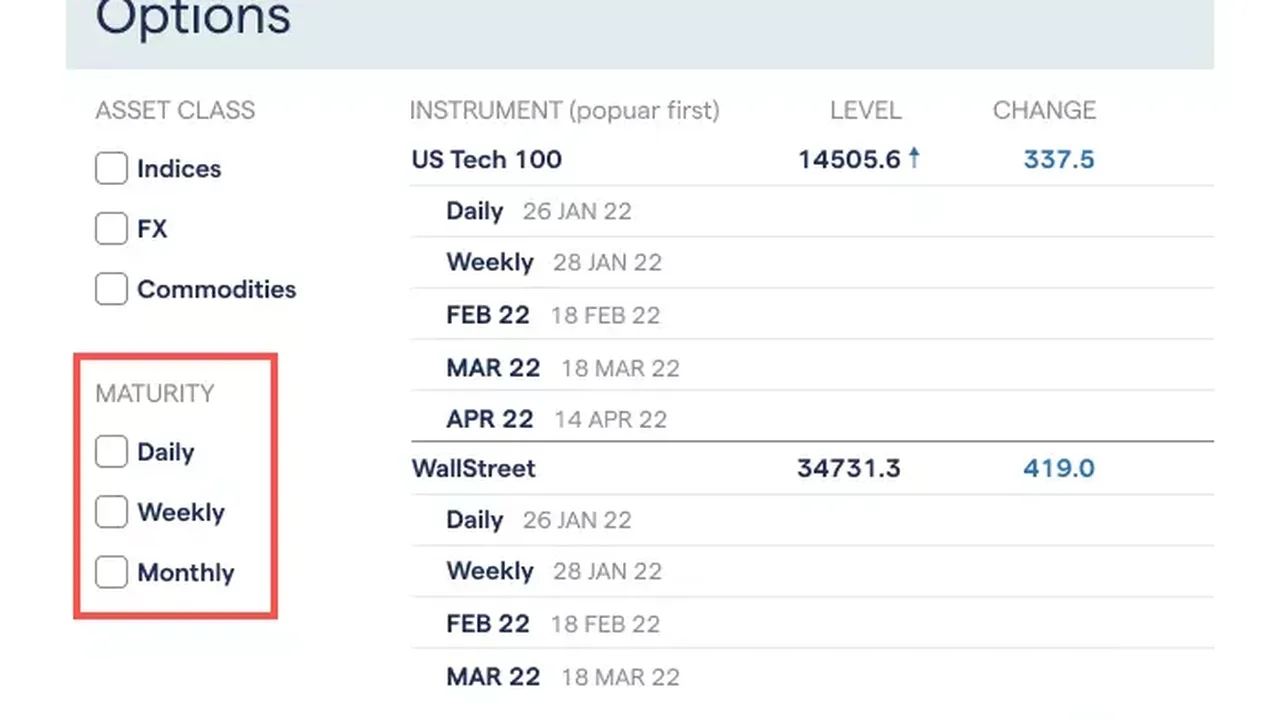
6. Decide whether to buy or sell calls or puts
You can go long in two ways – buy a call or sell a put. Likewise, you can go short in two ways – buy a put or sell a call. Each has its own advantages and risks. It’s important that your prediction is supported by sound research, such as technical and fundamental analysis.
Note that if you sell a call option without having ownership of the underlying, there’s a risk that the call might be exercised, and you’ll be liable for the short position that may exceed the initial amount you used to open the position.
That’s why you need to take steps to manage your risk effectively and trade closer to the expiry date to experience limited fluctuations.
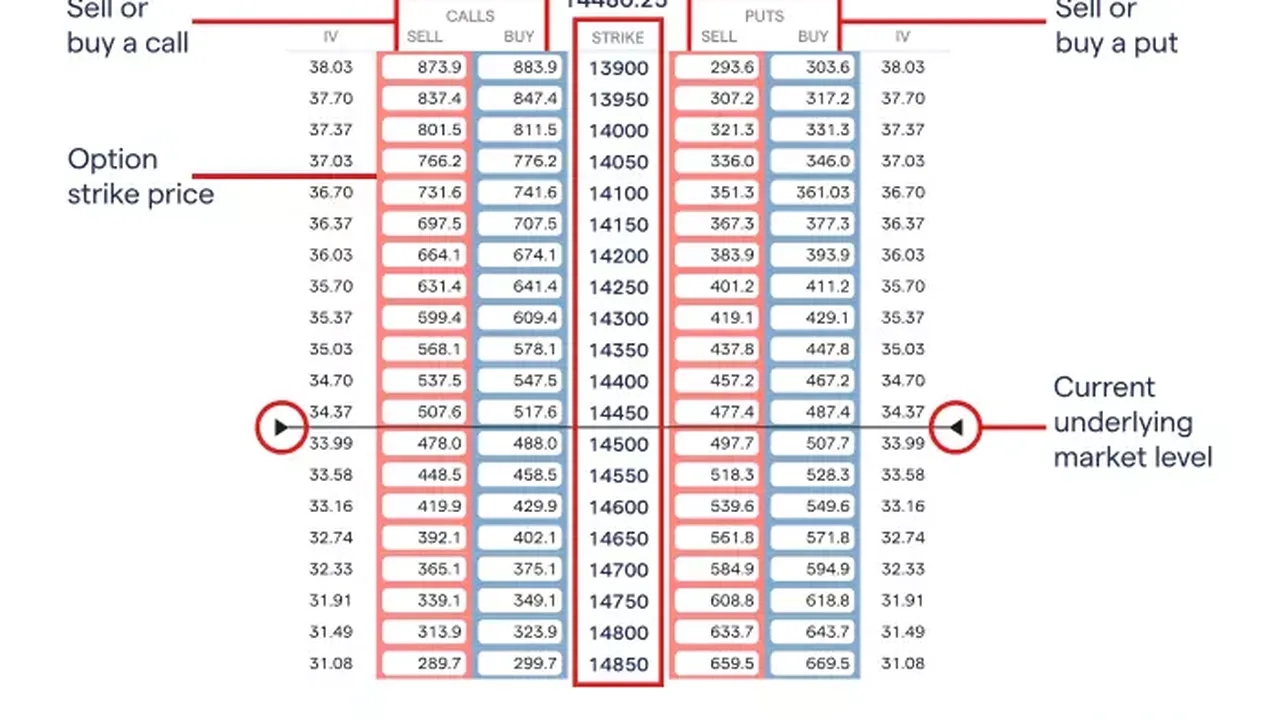
7. Open and monitor your position
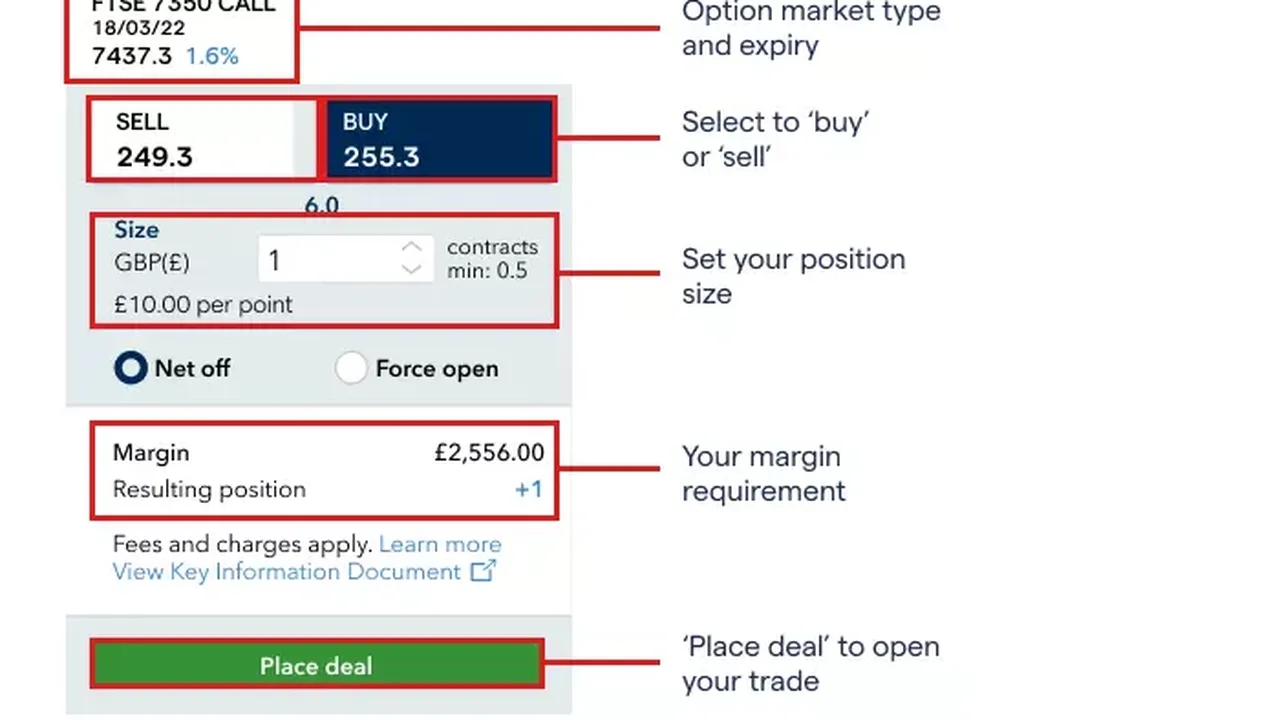
Once you’re on our platform, you’ll have to select a market you want to get exposure to. You’ll need to set the timeframe, choosing between daily, weekly and monthly options trading. Thereafter, you’ll open a deal ticket and decide whether you choose to buy or sell a call or put option.
Once you’re done, you’ll choose the strike price, then the position size you want to risk, and place your trade. Remember to set risk management tools to mitigate losses.
When your position is opened, you’ll be responsible for monitoring the movement of your trade.
1 Tax laws are subject to change and depend on individual circumstances. Tax law may differ in a jurisdiction other than the UK.
2 Best trading platform as awarded at the ADVFN International Financial Awards 2022 and Professional Trader Awards 2022.


