


How can you get exposure to an IPO?
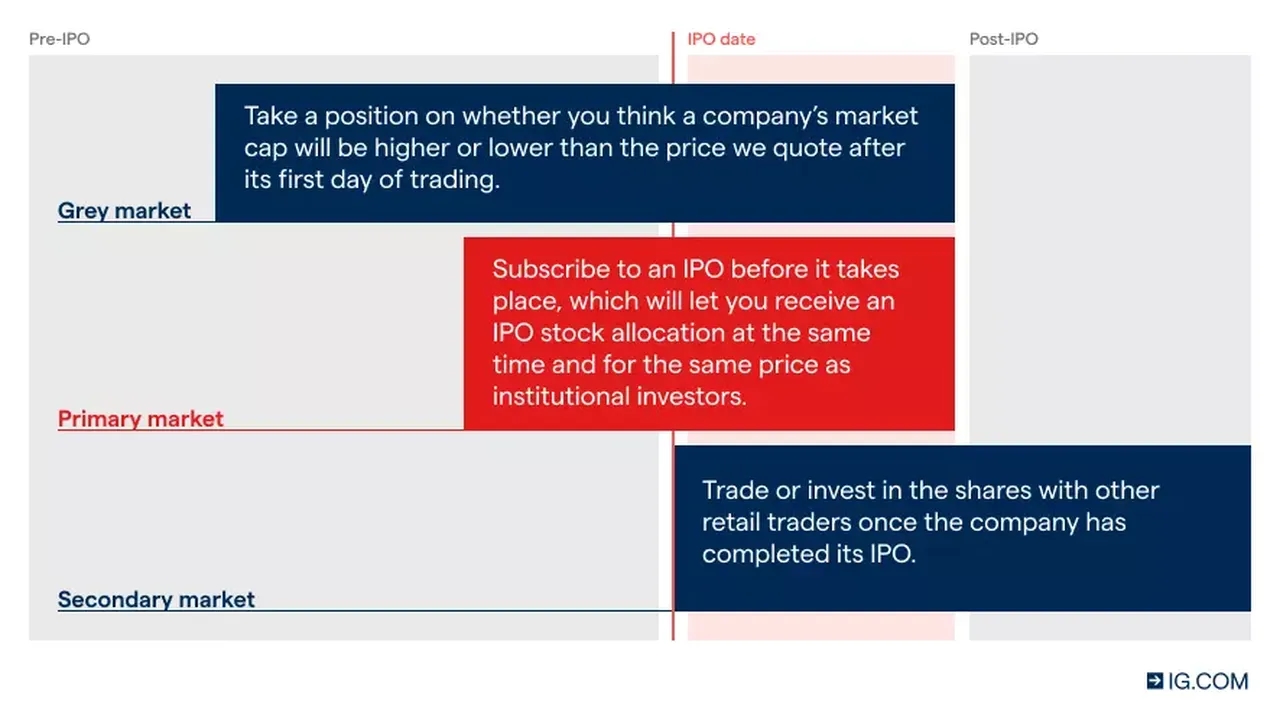
Grey market
If a company’s IPO has a lot of public interest, we may offer a ‘grey market’ before the IPO takes place. This’ll let you speculate on the company’s estimated market cap at the end of its first day of trading.
The price that we quote for a grey market offering will be based on our prediction of the company’s market cap at the end of its first trading day.
You’ll ‘buy’ (go long) if you think the company’s market cap will be higher than the price we quote
You’ll ‘sell’ (go short) if you think the company’s market cap will be lower than the price we quote
Create a trading account to access our grey markets
Primary market: buying at the IPO price
If a company has filed for an IPO and you want to invest in the stock, you can subscribe to the IPO ahead of the offering. By doing this, you’ll receive a stock allocation at the same time and for the same price as institutional investors, without needing to wait for the secondary market to open to take your position.
You can access the primary market by creating a share dealing account with us.
Create a share dealing account to buy at the IPO price
Secondary market: buying the stock after the IPO – investing or trading
Once the company has listed, the secondary market will open. This is where retail investors can buy and sell the stock between themselves, or where you can trade on a share’s price movements with derivatives.
To invest on the secondary market, you’ll need a share dealing account. Investing gives you direct ownership of the stock – making you a company shareholder. To trade on the secondary market, you’ll use either spread bets or CFDs. With these leveraged products, you won’t own the shares when you trade, but you’ll be able to speculate on the share price whether it goes up or down. Note that trading on leverage increases your risk of losing more than your deposit.
Learn more about spread betting and CFD trading
With us, you can take a position on the secondary market for UK IPOs as soon as it opens – which is usually at 8am (UK time) on the day of the IPO. US IPOs might take a few hours to be available to traders, which is the case for all brokers.
Make sure you always have an effective risk management strategy in place when trading an IPO, as the share price could experience increased volatility right after the listing.
IPO trading steps
Learn how IPOs work
The IPO process starts long before the shares list on an exchange. First, a company has to make the decision to go public. This is followed by a financial audit of the business and a registration process. The news of an upcoming IPO will usually be released a few months before the planned listing – which gives you time to study a company’s fundamentals and decide whether you want to take a position on its shares.
Learn more about how the IPO process works
Choose an IPO to take a position on
There are hundreds of UK, US and international IPOs every year. Find out more about upcoming IPOs or sign up to our exclusive mailing list to find new IPO stocks. By subscribing, you'll receive updates on any changes to expected IPOs, as well as the latest news on upcoming listings.
Get the latest IPO news
Decide how to take a position on an IPO
With us, you can invest in the company’s shares with a share dealing account on the primary or secondary market. Investing in the primary market lets you take a position on the company’s stock pre-IPO; investing in the secondary market will give you ownership of the shares once the company has completed its IPO.
You can also trade on a company’s market cap pre-IPO with our exclusive grey markets, or speculate on the company’s share price on the secondary market with derivatives like spread bets and CFDs.
Investing in shares
You can create a share dealing account to invest in upcoming IPOs on the primary market or to invest in shares once they’re available on the secondary market.
When you’re investing, you’ll pay the full value of the position up front which will give you direct ownership of the company’s stock. This’ll make you a shareholder, and you’ll be eligible to receive any dividends that the company pays, and get shareholder voting rights if the company grants them.
With us, you can invest in US shares for zero commission and UK shares from as little as £3.2
Trading derivatives
You can create a leveraged trading account to speculate on a share’s price movements with derivatives like spread bets and CFDs. Before the IPO, you can use these derivatives to trade our grey market, and after the IPO you can use them to speculate on a stock’s price rising (by going long) and falling (by going short).
You might choose derivatives because they enable you to open a position with leverage, which requires a small deposit (margin) rather than committing the full value of the shares upfront. This can magnify profits and losses, as both will be calculated from the full exposure of the trade, not just the margin you put up a deposit. Derivatives also offer various tax benefits.3
Build your IPO trading plan and strategy
A good trading plan and risk management strategy will provide guidance on how to find opportunities, and when to take profits and cut losses. There are several ways you can minimise your risk, which include attaching stops to your positions. Stops will close your trade at a certain level if the market moves against you, minimising your losses.
To learn more about trade planning and risk management, join IG Academy. It’s a great tool for developing your knowledge on all things trading, with free online courses, webinars and seminars.
Quick fact
The first ever IPO was launched by the Dutch East India Company in 1602, which issued public shares to raise funds for its voyages.
IPO trading and investing strategies
We’ve highlighted some IPO trading or investing strategies below. Remember that before using any of these strategies, you should take steps to manage your risk.
1. Invest in an IPO primary market
If you subscribe to the IPO ahead of the offering, you’ll get a stock allocation at the same time and for the same price as institutional investors, without needing to wait to trade the shares on the secondary market. This means that you can capitalise on the initial excitement surrounding an IPO – particularly if the outlook for the company is strong and a share price increase is expected.
The tables below show the data for how companies’ share prices performed after the first day, first week, and first month of their IPOs.
First day
2017 | 2018 | 2019 | 2020 | 2017-2020 | |
All IPOs | 8.6% | 8.7% | 8.5% | 6.6% | 8.3% |
Main market | 6.3% | 5.7% | 7.4% | 4.6% | 6.1% |
AIM | 11.2% | 12.1% | 10.7% | 9.0% | 11.2% |
First week
2017 | 2018 | 2019 | 2020 | 2017-2020 | |
All IPOs | 9.3% | 10.3% | 11.0% | 9.0% | 9.8% |
Main market | 5.6% | 4.8% | 9.4% | 4.4% | 5.9% |
AIM | 13.6% | 16.5% | 14.3% | 14.6% | 14.7% |
First month
2017 | 2018 | 2019 | 2020 | 2017-2020 | |
All IPOs | 8.0% | 9.5% | 13.9% | 1.5% | 8.4% |
Main market | 5.3% | 2.8% | 13.7% | -0.7% | 5.2% |
AIM | 11.0% | 17.3% | 14.2% | 4.2% |
But, remember to take steps to manage your risk if you’re going to use this strategy. Excitement often leads to increased volatility, which could mean that your positions experience sudden shifts in price – which might lead to heavy losses without a risk management strategy in place.
Learn more about risk management
2. Let the stock establish some price discovery
Taking a position on an IPO on its opening day can be very different compared to other market opportunities. Support and resistance levels haven’t been established yet and people are often excited with certain expectations. One of the best ways to handle hot IPOs is to wait for the morning volatility to cool off and allow the stock to establish some ‘price discovery‘.
This will give you levels to trade off and price action will likely be less erratic and volatile. Having levels to trade off helps you manage risk, which is your number one goal when trading an IPO. Placing hard stops and managing trade size is a must.
Learn more about technical analysis
3. Wait for the lock-up period to end
IPO shares are often subject to a ‘lock-up’ period. These can last up to six months and mean that existing shareholders cannot sell their shares immediately after a listing. If you notice that they are holding on to shares after this period, it could mean that shareholders think there is potential for growth and it’s time to buy because the share price could remain stable or increase.
But, if the share price falls after the lock-up period, it could indicate that confidence in the company is low. This could be an opportunity to go short with derivatives like spread bets and CFDs.
Following this strategy means that you’ll miss out on the initial market volatility that IPOs often cause – which could be a good or a bad thing, depending on your individual appetite for risk. There’s no saying that you can’t combine these strategies. For example, you might choose to buy and hold some shares from the primary market and wait for the lock-up period to end, but you could also trade the secondary market volatility with derivatives like spread bets and CFDs on the day of the IPO.
Learn more about investing in primary market
4. ‘Buy’ or ‘sell’ the IPO stock with derivatives
If you want to capitalise on upward and downward movements in a company’s share price on the day of its IPO, you could take a position with derivatives like spread bets and CFDs. You can use these products to ‘buy’ (go long) if you think the company’s share price will rise, or ‘sell’ (go short) if you think it’ll fall.
But, bear in mind that spread bets and CFDs are leveraged products, and leverage can increase both your profits and your losses.
Learn more about the impact of leverage on your trading
Open your first IPO position
Once you’re ready to start trading or buying shares, you can open your first IPO position. Remember that there are a variety of ways to take a position with us – including trading before, during or after the IPO with our range of accounts and offerings.
Before you open your IPO position, make sure you take steps to manage your risk like adding stops and limits to your open positions, and by monitoring your positions closely.
FAQs
Yes, you can make money on IPOs if you correctly predict share price movements. With us, you can take a position before the IPO through a grey market, during the IPO on the primary market, or after the IPO on the secondary market.
Trading an IPO means that you’ll be taking a position with derivatives like spread bets and CFDs. You can use these to trade our grey market offering, as well as to take a position on the secondary market on the day of the IPO.
With us, you can also invest in an IPO. Just create a share dealing account – which will also give you access to the primary market offering on an IPO. This’ll let you get a stock allocation at the same time and for the same price as institutional investors – meaning you don’t need to wait for the secondary market to open.
IPO shares – the shares acquired by investors before the listing – are often subject to a ‘lock-up’ period. These can last up to six months and mean that private investors who held shares prior to the IPO cannot sell their shares immediately after a listing. However, the general public won’t be affected by lock-up periods, as they exist mainly to prevent those who acquired shares before an IPO from immediately selling the stock.
Try these next
After-hours share trading
Start trading over 70 US markets out of hours
IPO trading
Learn how to make the most of IPOs and grey markets
How to trade shares
Discover how to buy and trade shares
1 Based on our IPO offering that includes pre-IPO grey markets, primary market access, and trading and investing on the secondary market.
2 Trade in your share dealing account three or more times in the previous month to qualify for our best commission rates. Please note published rates are valid up to £25,000 notional value. See our full list of share dealing charges and fees.
3 Tax laws are subject to change and depend on individual circumstances. Tax law may differ in a jurisdiction other than the UK.