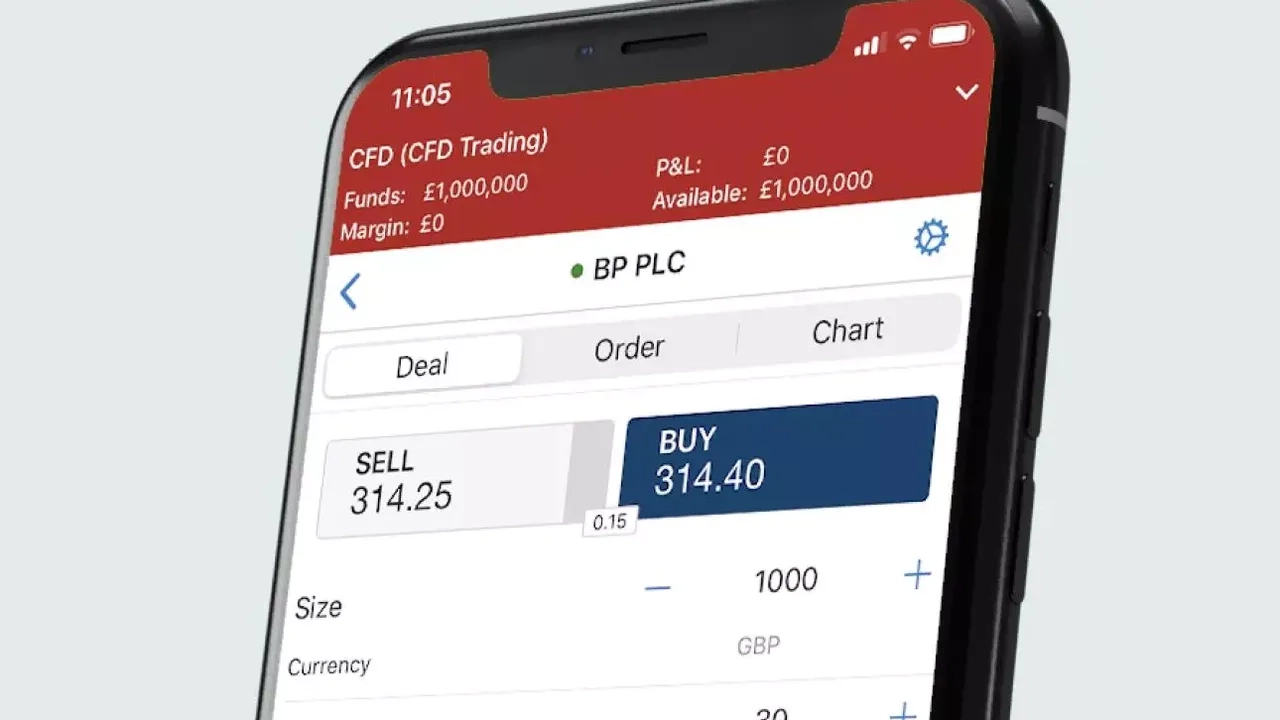


What’s the difference between CFDs and investing?
When investing in shares (also known as share dealing) you are taking direct ownership of the asset, for example company shares. You’ll need to pay the full value of the position upfront
With CFDs, you’ll be speculating on price movements – without taking ownership – and putting a margin amount down as leverage to open your position. This increases both profits and losses
We offer CFD trading on shares, indices, commodities, forex, options, futures and more. Share dealing is available for investing in shares and ETFs. View our markets below.
CFD trading explained
When you trade CFDs, you’re entering into a contract for difference (CFD), which is an agreement to exchange the difference between the opening and closing price of your position.
CFDs are advantageous if you’re a trader with a short-term outlook. This is because CFD trades enable you to speculate on the price of an asset by going long (buying) or going short (selling).
One of the main benefits of CFD trading is the ability to use leverage, giving you full market exposure while only having to commit a deposit to open your position(known as a margin). So, if you wanted to open a £100 CFD trade on HSBC shares, you’d put down a margin (often 20%) to trade the movement of HSBC’s share price – an initial sum of £20.
But, trading with leverage carries risk. While it can amplify your profits, it can also magnify your losses. That’s because any profit or loss is calculated using the full size of the position, rather than your margin amount. So, with our HSBC example, your profit or loss would be calculated on the full £100, not your £20 margin. Learn how to manage your risk.
Generally, CFD trades in the UK are also free from stamp duty, but you’ll pay capital gains tax on any profits. They’re also great for hedging a non-leveraged investment portfolio, as any losses can be offset against profits for tax purposes.1 Remember that tax law may differ in a jurisdiction other than the UK. These laws are subject to change and depend on individual circumstances. If you’re new to the concept of hedges, learn more about hedging in our guide.
If CFD trading isn’t for you, we also offer spread bets, which enable you to trade tax-free.1 Just like CFDs, spread bets let you speculate on the direction of an asset’s price movements rising or falling, and your profit or loss is determined by the accuracy of your prediction and the size of the market movement. Learn more about the differences between spread bets and CFDs.
Investing explained
When you invest, you’re taking direct ownership of shares in a company or ETF. Because of this, investing might be preferable if you have a positive long-term outlook on that share or ETF because you’ll stand to benefit from any price increases. You could also receive dividends and voting rights if available to shareholders.
Leverage isn’t available when you’re investing directly, so you’ll have to commit the full value of the position upfront. But, this also means that your maximum risk is capped at the total cost of your investment. For example, if you bought £1000 worth of shares, the maximum you could lose is £1000 – assuming that the share price falls all the way to zero.
Remember that, when you invest, you can only profit when share prices or the value of an ETF rises above the price that you opened your investment. This is different to CFD trading, which enables you to profit from shares or ETFs that are rising or falling in value.
&w=3840&q=100)
CFDs vs investing in brief
| CFD trading | Investing |
Which markets are available? | 15,000+ markets including shares and ETFs, indices, forex pairs, commodities and more | Just under 12,000+ global shares and ETFs |
What are is the deposit required to open a position? | Initial outlay for leveraged trades are 20%-25% of the total position size or, in the case of forex CFDs, from 3.332 However, with share CFDs, it’s important to remember that you would pay a commission amount after opening the position. | You’ll pay the full value of the position upfront. |
Can you go short? | Yes, you can go long and speculate prices rising, as well as go short to speculate on prices falling. | Not as standard. To short stocks with traditional short-selling, you’d need to borrow shares, likely from a broker, sell those shares and then buy them back later. However, we don’t offer this. |
Are there any tax benefits? | You won’t generally pay stamp duty, but you’ll pay capital gains tax on any profits.1 Losses can be offset against profits as a tax deduction.1 |
&w=3840&q=100)
Share CFDs vs share dealing: an example
Let’s say you want exposure to Barclays shares, currently valued at 208p each. The table below explains the differences between them by using an example.
| Share CFD | Share dealing |
Underlying price at open | 208.74p | 208.74p |
Our buy price at open | 208.78p (0.04-point spread) | 208.74p (there is no spread on share dealing products) |
Position size | You buy 2000 share CFDs at the buy price of 208.78p | You buy 2000 shares at the share price of 208.74p |
Deposit required to open the position | £835.12 (20% margin of £4175.60 [208.78 x 2000]) | Cost is £4174.80 (208.74p at their full price x 2000 shares) |
Stamp duty1 | £0 | £20.87 (stamp duty is a flat rate of 0.5% of the total share price, so £20,87 = 0.5% of £4174.80) or £0 in an ISA |
FAQs
Yes, you can take a position on shares with both CFDs and investing in shares. Investing lets you take direct ownership of shares, while CFD trading lets you speculate on share prices without having to own them. When you invest, you can profit if the share price rises above what you bought them for. When you trade CFDs, you can profit from prices that are rising by going long, or from prices that are falling by going short.
One difference is that trading share CFDs won’t give you ownership of the shares in question, while share dealing will.
But, share CFDs does mean you can speculate on share prices rising by going long, as well as falling by going short. This isn’t available when investing in shares, but you can profit from upwards movements in a share’s price.
For this reason CFDs are also more complex financial products which can be higher risk trades than share dealing. This is because, with CFDs, your profits and losses can far outweigh your initial outlay.
When you trade CFDs, you won’t generally have to pay stamp duty on your profits as you don’t own the underlying shares. You’ll need to pay capital gains tax on any profits, but you can offset your losses against your profits for tax purposes.1 Learn more about how CFDs are taxed.
If you decide to invest in shares, you’d pay stamp duty on each investment and capital gains tax on any profits. The exception is investments made via a tax-free stocks and shares ISA or SIPP.1