Spread bets and CFDs are complex instruments and come with a high risk of losing money rapidly due to leverage. 70% of retail investor accounts lose money when trading spread bets and CFDs with this provider. You should consider whether you understand how spread bets and CFDs work, and whether you can afford to take the high risk of losing your money.

ISA & Investing
Trading
Crypto
Learn
More
IG
Open accountLog in

I want to

  • Invest tax-freeStocks & Shares ISAISA
  • Start building my portfolioGeneral Investment AccountGIA
  • Save for their futureJunior ISAJISA
  • Invest for my retirementSelf-invested Personal PensionSIPP
  • Transfer my portfolio to IG
  • View promotional offers

What to invest in

  • Stocks
  • ETFs
  • Bonds
  • Funds

I want to

  • Trade tax-freeSpread BettingSB
  • Trade CFDsCFD tradingCFD
  • Trade options
  • Trade futures
  • Trade spot
  • Trade after hours
  • Trade over the weekend
  • Try risk-free firstDemo account
  • Trading platforms and tools
  • Open a trading accountTrading account

Markets

  • Commodities
  • Indices
  • Forex
  • Stocks
  • ETFs
  • Pre-IPO
  • Bonds & rates

Shares

  • NVIDIANVIDIANVDA
  • APPLEAPPLEAAPL
  • ALPHABETALPHABETGOOG
  • TESLATESLATSLA
  • MICROSOFTMICROSOFTMSFT
  • BPBPBP

I want to

  • Buy and sell cryptoCrypto accountCrypto
  • Transfer to IG
  • Check live prices
  • Learn about crypto

Popular crypto

  • BitcoinBitcoinBTC
  • EthereumEthereumETH
  • SolanaSolanaSOL
  • RippleRippleXRP
  • CardanoCardanoADA
  • DogecoinDogecoinDOGE
Beat the streetWin up to £100,000Compete for free

I want to learn about

  • Investing basics
  • How trading works
  • Cryptocurrency
  • Current market news
  • Trading and investing terms

Resources

  • The Art of Investing podcast
  • IG Live
  • Seminars and webinars
  • Economic calendar
  • Beat the street

Newsletters and briefings

  • The week aheadWeekly market events to watch
  • Trade of the weekAnalysis on specific markets
  • Morning callDaily guide to market-moving events

Help

  • Help & support
  • Contact us
  • Charges & fees

About IG

  • Who we are
  • How IG compares
  • Media centre

Professional

  • Apply
  • Understand the requirements

Institutional

  • Get in touch
  • Liquidity and execution
  • Prime brokerage
  • White label solutions

Spread bets and CFDs are complex instruments and come with a high risk of losing money rapidly due to leverage. 70% of retail investor accounts lose money when trading spread bets and CFDs with this provider. You should consider whether you understand how spread bets and CFDs work, and whether you can afford to take the high risk of losing your money.

13 Jul 26

5 min read

What is an ETF? Types and how they compare to funds
Understanding what an ETF is makes a useful starting point whether you are looking to diversify cheaply, gain exposure to a specific market, or compare your options against mutual funds and index funds. This guide covers what ETFs are, how they work, the different types available, and how to access them with us.

ETF stands for exchange-traded fund. The name captures two defining features: it is a fund (holding a collection of assets), and it is exchange-traded, meaning it is bought and sold on a stock exchange during market hours at a live price.

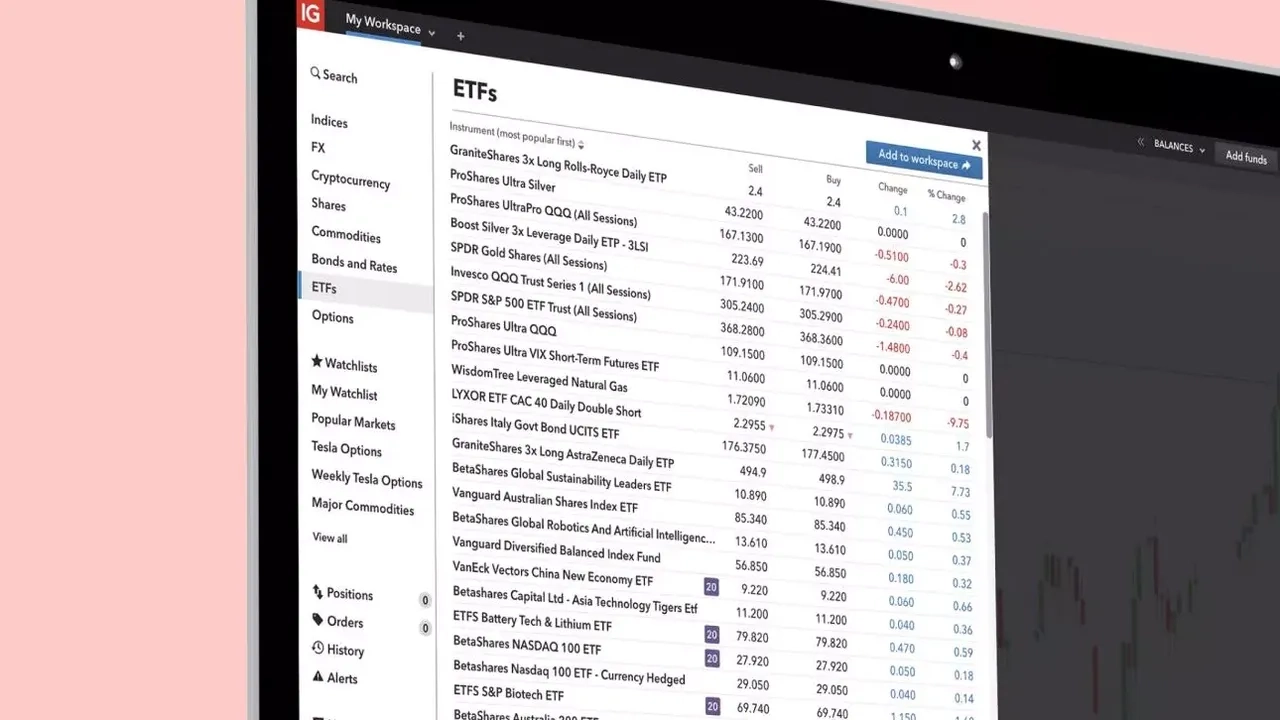
A computer screen displaying an ETF trading platform with a list of ETFs, their prices, and percentage changes.
Oli Robertson
Written by

Oli Robertson

Market Analyst
Date publishedJul 13, 2026
Oli Robertson
Written by

Oli Robertson

Market Analyst
Date publishedJul 13, 2026

Get the mobile app

Rated 4.5/5 on 90k+ reviews

What does ETF stand for?

This distinguishes ETFs from traditional mutual funds, which are priced once at the end of each trading day. You can read more about that distinction in our guide to index funds vs ETFs.

Key Takeaway

ETF stands for exchange-traded fund, a pooled fund that trades on a stock exchange like a share. Most ETFs passively track an index such as the S&P 500 or FTSE 100 which keeps fees lower than most active funds.

How do ETFs work?

ETFs work by pooling investor capital to buy a collection of assets that mirror a target index or strategy. Here is the process from start to finish:

  1. An ETF provider (such as iShares, Vanguard, or SPDR) creates the fund and sets its investment objective, for example to track the FTSE 100.

  2. The fund buys the underlying assets, whether shares, bonds or commodities, in proportions that replicate the target index.

  3. Shares of the ETF are listed on a stock exchange. Investors can buy and sell them throughout the trading day at market prices.

  4. The ETF price tracks the value of its underlying holdings. If the FTSE 100 rises 1%, a FTSE 100 ETF should rise by approximately 1%.

  5. Income from the holdings, such as dividends, is either paid out to investors (a distributing ETF) or reinvested within the fund (an accumulating ETF), although there are potential tax ramifications to be considered.                                                                                        

ETFs in numbers

$19.85tn+   Global ETF assets under management *

15,000+   ETF products available globally *

0.03%   Ongoing charge for the lowest-cost ETFs +

* Assets in the global ETF industry hit record USD19.85 trillion in 2025: ETFGI - ETF Express

+ The cheapest funds for cost-conscious investors in 2025 | Trustnet

All figures from end of 2025

ETF vs mutual fund vs index fund

These three terms are often confused. The key distinction is this: an index fund is an investment strategy, one that passively tracks an index, while an ETF is an investment structure, a fund that trades on an exchange. Most ETFs use an index fund strategy, but not all. Some ETFs are actively managed, meaning a fund manager physically chooses the investments, often charging a premium for doing so. This is also no guarantee of better results versus managing one’s own investing

Feature

ETF

Mutual Fund

Index Fund

How it’s traded

Exchange (intraday)

Via fund manager (end of day)

Via manager or exchange

Pricing

Real-time market price

Daily NAV

Daily NAV or real-time

Management style

Usually passive

Often active

Always passive

Typical costs (OCF)

0.03%-0.50%

0.5%-2%+

0.05%-0.25%

Minimum investment

Price of 1 share

Often £500-£1,000+

Often £100-£500+

ISA eligible?

Yes

Yes

Yes

Want to find out more about ETFs?

Learn how trading and investing in ETFs works

Trade ETFsInvest in ETFs

Types of ETF available to UK investors

ETFs span a wide range of asset classes, geographies and strategies. The most common types include:

  • Equity ETFs - track a stock index such as the S&P 500, FTSE 100, or MSCI World Often considered the most popular ETF category globally.

  • Bond ETFs - hold government or corporate bonds, offering income and typically lower volatility than equity ETFs.

  • Commodity ETFs - provide exposure to gold, silver, oil, or agricultural products via physical holdings or futures contracts.

  • Sector and thematic ETFs - focus on specific industries such as technology or healthcare, or investment themes including clean energy and AI.

  • Multi-asset ETFs - blend equities, bonds and other assets in one fund, offering built-in diversification.

  • Smart beta/factor ETFs - use rules-based strategies weighted by factors like value, momentum, or low volatility rather than market capitalisation.

Taking a diversified approach is usually recommended (i.e.: investing in a variety of different ETFs, as well as others), to avoid having a single point of failure. Which strategies you choose depends on your individual risk appetite or tolerance.

See our roundups of the best UK ETFs and the best global ETFs to watch. You may also want to read about what an ETP is and how it differs from an ETF.

Quick fact

UCITS ETFs are the standard structure for UK and European retail investors. UCITS rules require diversification, cap single-stock exposure at 20%, and mandate daily liquidity, making them one of the most tightly regulated investment structures available.

Advantages and risks of ETFs

ETFs have grown rapidly in popularity for good reason, though they are not without risk. Here are some of the commonly understood advantages and risks associated with ETFs.

Advantages

Risks

Diversification in a single trade, as one ETF can hold hundreds of stocks or bonds

Market risk, as ETFs fall in value when their underlying markets fall

Low cost, with most passive ETFs charging between 0.03% and 0.20% per year

Tracking error, meaning an ETF may not perfectly replicate its index

Intraday liquidity, so you can buy and sell at market prices throughout the trading day

Liquidity risk, since some niche ETFs have low trading volumes

Transparency, as most ETF providers publish their full holdings daily

Currency risk, as international ETFs expose you to foreign exchange movements

Tax efficiency, with generally lower capital gains distributions than active funds

Concentration risk, since some sector or thematic ETFs hold relatively few companies

ISA and SIPP eligible, so they can be held in tax-efficient wrappers

Counterparty risk with synthetic ETFs, which use derivatives rather than holding assets directly

Quick fact

The global ETF industry surpassed $19 trillion in assets under management in 2025, more than ten times the level seen in 2010. Passive investing via ETFs now accounts for over half of all US equity fund assets.*


* ETFGI, 2025

It's time to get started

Invest in or trade ETFs today

Create investment accountCreate trading account

Trade. Invest. Progress.

Progress starts here. Invest with purpose. Trade with confidence. Build wealth with momentum. It starts with IG.

Important information For you

  • Trading fees
  • Share dealing fees
  • Smart portfolio fees
  • Crypto fees
  • Money protection
  • Vulnerability

Popular ways to trade & invest

  • Spread betting
  • CFD trading
  • Stocks & Shares ISA
  • Share dealing
  • SIPP
  • Crypto
  • Trading platforms
  • Explore other ways to trade

Useful links

  • Help and support
  • About
  • Learn
  • Subscribe
  • Marketing partnerships
  • Careers
IG

© 2003-2026

  • Sitemap
  • Cookies
  • Terms and agreements
  • Privacy
  • Investors
  • Modern slavery act
  • MIFIDPRU 8 Disclosure
  • 
  • 
  • 
  • 
  1. Home
  2. Learn
  3. Investing
  4. What is an ETF? Types and how they compare to funds

Spread bets and CFDs are complex instruments and come with a high risk of losing money rapidly due to leverage. 70% of retail investor accounts lose money when trading spread bets and CFDs with this provider. You should consider whether you understand how spread bets and CFDs work and whether you can afford to take the high risk of losing your money. 

Professional clients trading spread bets and CFDs can lose more than they deposit.

The value of shares, ETFs and other ETPs bought through a share dealing account, a stocks and shares ISA or a SIPP can fall as well as rise, which could mean getting back less than you originally put in. Past performance is no guarantee of future results. Some ETPs carry additional risks depending on how they’re structured, investors should ensure they familiarise themselves with the differences before investing.

The SIPP is provided by Options UK Personal Pensions LLP (OC345142), authorised and regulated by the Financial Conduct Authority (FRN 501747). IG provides the associated investment account and does not operate the SIPP

Crypto - Don’t invest unless you’re prepared to lose all the money you invest. This is a high-risk investment, and you should not expect to be protected if something goes wrong. Take 2 mins to learn more.

Share dealing and IG Smart Portfolio accounts provided by IG Trading and Investments Ltd, CFD accounts are provided by IG Markets Ltd, spread betting provided by IG Index Ltd, cryptoassets services are provided by IG Digital Assets Ltd.

IG is a trading name of IG Trading and Investments Ltd (a company registered in England and Wales under number 11628764), IG Markets Ltd (a company registered in England and Wales under number 04008957) and IG Index Ltd (a company registered in England and Wales under number 01190902). Registered address at 88 Wood Street, London, EC2V 7QR. IG Markets Ltd (Register number 195355), IG Trading and Investments Ltd (Register Number 944492) and IG Index Ltd (Register number 114059) are authorised and regulated by the Financial Conduct Authority.   

The information on this site isn’t directed at residents of the United States, Belgium or any particular country outside the UK and isn’t intended for distribution to, or use by, any person in any country or jurisdiction where such distribution or use would be contrary to local law or regulation.

TradingView Logo
  • Get between £25 to £300 in bonus cashWhen you invest £300 or more. This promotion runs from 00:00 on 1 November 2026 to 23.59pm 30 November 2026, UK time.T&Cs apply.Code: CASHBACK300NOV
  • Bonus Shares PromotionGet between £50 to £1000 in bonus shares when you invest £500 or more.T&Cs apply.Code: SHARES1KNOV
  • Boosted interest rate of 7.00% AEROn your uninvested cash balance up to £10,000 when you invest £500 or more.T&Cs apply.Code: EARN7NOV