What is an ETF? Types and how they compare to funds
Understanding what an ETF is makes a useful starting point whether you are looking to diversify cheaply, gain exposure to a specific market, or compare your options against mutual funds and index funds. This guide covers what ETFs are, how they work, the different types available, and how to access them with us.
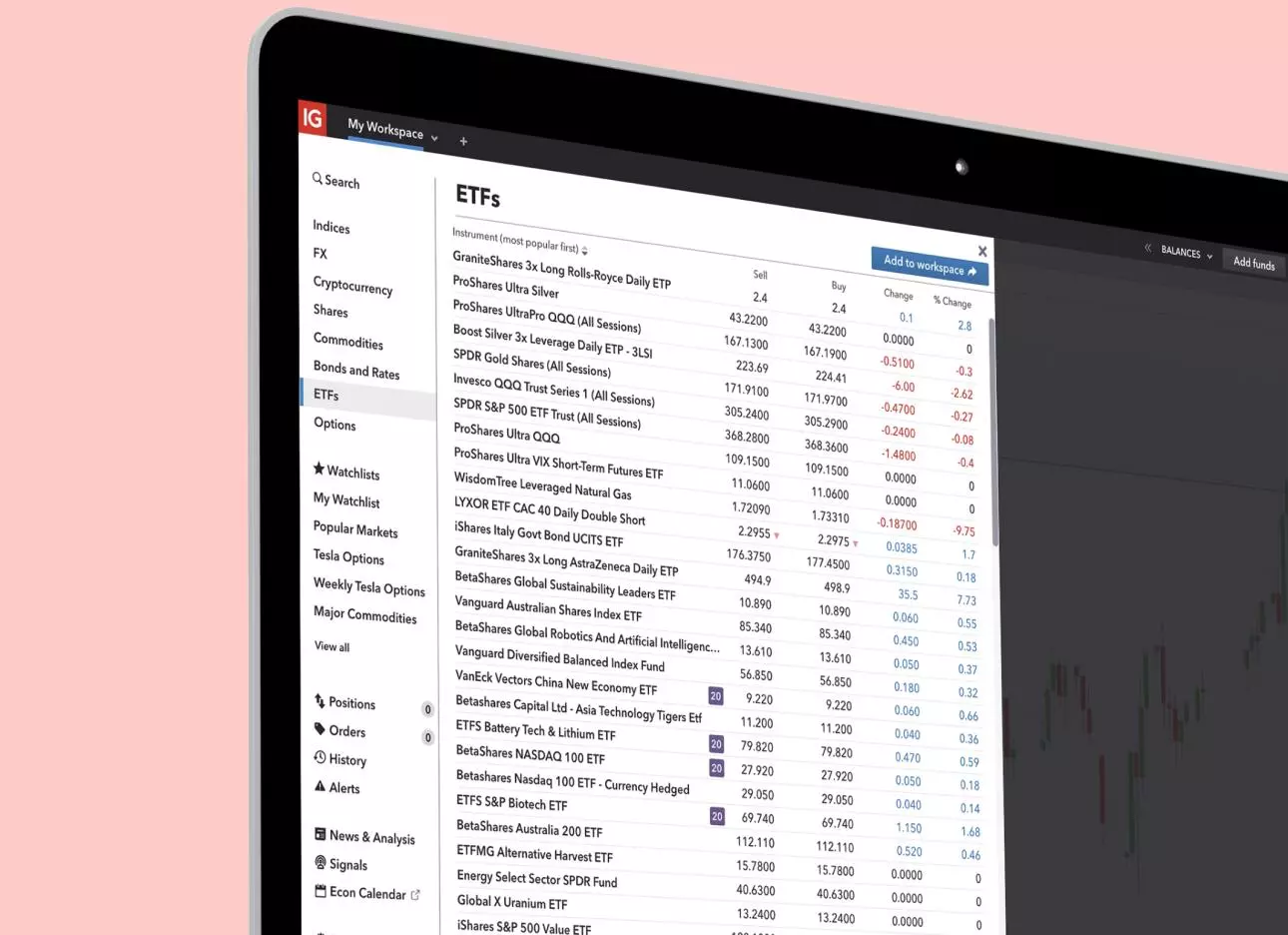

What does ETF stand for?
ETF stands for exchange-traded fund. The name captures two defining features: it is a fund (holding a collection of assets), and it is exchange-traded, meaning it is bought and sold on a stock exchange during market hours at a live price.
This distinguishes ETFs from traditional mutual funds, which are priced once at the end of each trading day. You can read more about that distinction in our guide to index funds vs ETFs.

How do ETFs work?
ETFs work by pooling investor capital to buy a collection of assets that mirror a target index or strategy. Here is the process from start to finish:
1. An ETF provider (such as iShares, Vanguard, or SPDR) creates the fund and sets its investment objective, for example to track the FTSE 100.
2. The fund buys the underlying assets, whether shares, bonds or commodities, in proportions that replicate the target index.
3. Shares of the ETF are listed on a stock exchange. Investors can buy and sell them throughout the trading day at market prices.
4. The ETF price tracks the value of its underlying holdings. If the FTSE 100 rises 1%, a FTSE 100 ETF should rise by approximately 1%.
5. Income from the holdings, such as dividends, is either paid out to investors (a distributing ETF) or reinvested within the fund (an accumulating ETF), although there are potential tax ramifications to be considered.
ETFs in numbers
$19.85tn+ Global ETF assets under management *
15,000+ ETF products available globally *
0.03% Ongoing charge for the lowest-cost ETFs +
* Assets in the global ETF industry hit record USD19.85 trillion in 2025: ETFGI - ETF Express
+ The cheapest funds for cost-conscious investors in 2025 | Trustnet
All figures from end of 2025
ETF vs mutual fund vs index fund
These three terms are often confused. The key distinction is this: an index fund is an investment strategy, one that passively tracks an index, while an ETF is an investment structure, a fund that trades on an exchange. Most ETFs use an index fund strategy, but not all. Some ETFs are actively managed, meaning a fund manager physically chooses the investments, often charging a premium for doing so. This is also no guarantee of better results versus managing one’s own investing
Feature |
ETF |
Mutual Fund |
Index Fund |
How it’s traded |
Exchange (intraday) |
Via fund manager (end of day) |
Via manager or exchange |
Pricing |
Real-time market price |
Daily NAV |
Daily NAV or real-time |
Management style |
Usually passive |
Often active |
Always passive |
Typical costs (OCF) |
0.03%-0.50% |
0.5%-2%+ |
0.05%-0.25% |
Minimum investment |
Price of 1 share |
Often £500-£1,000+ |
Often £100-£500+ |
ISA eligible? |
Yes |
Yes |
Yes |

Want to find out more about ETFs?
Learn how trading and investing in ETFs works
Types of ETF available to UK investors
ETFs span a wide range of asset classes, geographies and strategies. The most common types include:
- Equity ETFs - track a stock index such as the S&P 500, FTSE 100, or MSCI World Often considered the most popular ETF category globally.
- Bond ETFs - hold government or corporate bonds, offering income and typically lower volatility than equity ETFs.
- Commodity ETFs - provide exposure to gold, silver, oil, or agricultural products via physical holdings or futures contracts.
- Sector and thematic ETFs - focus on specific industries such as technology or healthcare, or investment themes including clean energy and AI.
- Multi-asset ETFs - blend equities, bonds and other assets in one fund, offering built-in diversification.
- Smart beta/factor ETFs - use rules-based strategies weighted by factors like value, momentum, or low volatility rather than market capitalisation.
Taking a diversified approach is usually recommended (i.e.: investing in a variety of different ETFs, as well as others), to avoid having a single point of failure. Which strategies you choose depends on your individual risk appetite or tolerance.
See our roundups of the best UK ETFs and the best global ETFs to watch. You may also want to read about what an ETP is and how it differs from an ETF.
Want to practice first?
Try our demo account

Quick fact
UCITS ETFs are the standard structure for UK and European retail investors. UCITS rules require diversification, cap single-stock exposure at 20%, and mandate daily liquidity, making them one of the most tightly regulated investment structures available.
Advantages and risks of ETFs
ETFs have grown rapidly in popularity for good reason, though they are not without risk. Here are some of the commonly understood advantages and risks associated with ETFs.
Advantages |
Risks |
Diversification in a single trade, as one ETF can hold hundreds of stocks or bonds |
Market risk, as ETFs fall in value when their underlying markets fall |
Low cost, with most passive ETFs charging between 0.03% and 0.20% per year |
Tracking error, meaning an ETF may not perfectly replicate its index |
Intraday liquidity, so you can buy and sell at market prices throughout the trading day |
Liquidity risk, since some niche ETFs have low trading volumes |
Transparency, as most ETF providers publish their full holdings daily |
Currency risk, as international ETFs expose you to foreign exchange movements |
Tax efficiency, with generally lower capital gains distributions than active funds |
Concentration risk, since some sector or thematic ETFs hold relatively few companies |
ISA and SIPP eligible, so they can be held in tax-efficient wrappers |
Counterparty risk with synthetic ETFs, which use derivatives rather than holding assets directly |
Quick fact
The global ETF industry surpassed $19 trillion in assets under management in 2025, more than ten times the level seen in 2010. Passive investing via ETFs now accounts for over half of all US equity fund assets.*
* ETFGI, 2025
It’s time to get started
Invest in or trade ETFs today
ETF FAQs
What does ETF stand for?
ETF stands for exchange-traded fund, a pooled investment vehicle that holds a basket of assets and is bought and sold on a stock exchange during trading hours, just like an individual share.
What is the meaning of an ETF in simple terms?
Think of an ETF as a ready-made portfolio you can buy in a single trade. A FTSE 100 ETF, for example, instantly invests you across 100 of the UK's largest companies without needing to buy each share individually.
What is the difference between an ETF and a mutual fund?
The main differences are how they trade and how they are managed. ETFs trade in real time on an exchange, while mutual funds are priced once daily at their net asset value (NAV). ETFs are typically passively managed and lower cost.
What is the difference between an ETF and an index fund?
An index fund is an investment strategy, specifically passive management that tracks a market index. An ETF is an investment structure, a fund that trades on an exchange. Most ETFs use an index fund strategy, but some are actively managed, and some index funds are structured as OEICs (open-ended investment companies) rather than ETFs. See our full guide to index funds vs ETFs for a deeper comparison.
Are ETFs safe?
ETFs carry the same market risk as their underlying assets. If the market falls, so will an ETF tracking that market, and they are not capital-protected. UCITS ETFs sold to UK retail investors must meet diversification and liquidity requirements, which provides structural protection. However, the value of your investment can go down as well as up, and your capital is at risk.
Can I hold ETFs in an ISA?
Yes. Most ETFs listed on UK or European exchanges are eligible to be held in a stocks and shares ISA or a SIPP, allowing any gains and income to grow free of UK capital gains tax and income tax within your annual allowances.
What is a UCITS ETF?
UCITS stands for Undertakings for Collective Investment in Transferable Securities, the EU regulatory framework governing most ETFs available to UK retail investors. UCITS ETFs must meet strict rules on diversification, liquidity and investor protection.
What is an ETP and how does it differ from an ETF?
ETP, or exchange-traded product, is the umbrella term for all exchange-listed investment products, including ETFs, ETCs (exchange-traded commodities) and ETNs (exchange-traded notes). All ETFs are ETPs, but not all ETPs are ETFs. See our guide on what an ETP is for more.

Important to know
This information has been prepared by IG, a trading name of IG Markets Limited. In addition to the disclaimer below, the material on this page does not contain a record of our trading prices, or an offer of, or solicitation for, a transaction in any financial instrument. IG accepts no responsibility for any use that may be made of these comments and for any consequences that result. No representation or warranty is given as to the accuracy or completeness of this information. Consequently any person acting on it does so entirely at their own risk. Any research provided does not have regard to the specific investment objectives, financial situation and needs of any specific person who may receive it. It has not been prepared in accordance with legal requirements designed to promote the independence of investment research and as such is considered to be a marketing communication. Although we are not specifically constrained from dealing ahead of our recommendations we do not seek to take advantage of them before they are provided to our clients. See full non-independent research disclaimer and quarterly summary.
Connect with us


Spread bets and CFDs are complex instruments and come with a high risk of losing money rapidly due to leverage. 68% of retail investor accounts lose money when trading spread bets and CFDs with this provider. You should consider whether you understand how spread bets and CFDs work and whether you can afford to take the high risk of losing your money.
Professional clients trading spread bets and CFDs can lose more than they deposit.
The value of shares, ETFs and other ETPs bought through a share dealing account, a stocks and shares ISA or a SIPP can fall as well as rise, which could mean getting back less than you originally put in. Past performance is no guarantee of future results. Some ETPs carry additional risks depending on how they’re structured, investors should ensure they familiarise themselves with the differences before investing.
Crypto - Don’t invest unless you’re prepared to lose all the money you invest. This is a high-risk investment, and you should not expect to be protected if something goes wrong. Take 2 mins to learn more.
Share dealing and IG Smart Portfolio accounts provided by IG Trading and Investments Ltd, CFD accounts are provided by IG Markets Ltd, spread betting provided by IG Index Ltd, cryptoassets services are provided by IG Digital Assets Ltd.
IG is a trading name of IG Trading and Investments Ltd (a company registered in England and Wales under number 11628764), IG Markets Ltd (a company registered in England and Wales under number 04008957) and IG Index Ltd (a company registered in England and Wales under number 01190902). Registered address at Cannon Bridge House, 25 Dowgate Hill, London EC4R 2YA. IG Markets Ltd (Register number 195355), IG Trading and Investments Ltd (Register Number 944492) and IG Index Ltd (Register number 114059) are authorised and regulated by the Financial Conduct Authority.
The information on this site isn’t directed at residents of the United States, Belgium or any particular country outside the UK and isn’t intended for distribution to, or use by, any person in any country or jurisdiction where such distribution or use would be contrary to local law or regulation.
